The Problem with Corporate Training in Pune — And the Fix Most Companies Haven’t Tried Yet
Pune’s corporate identity has transformed dramatically over the past decade. What was once primarily an automotive and manufacturing city is now one of India’s biggest IT and knowledge economy hubs — Hinjewadi Phase 1, 2, and 3, Kharadi’s EON IT Park, Magarpatta Cybercity, SP Infocity in Hadapsar. Each zone is home to thousands of skilled professionals who are smart, ambitious, and deeply underserved by conventional corporate training. Experiential learning activities in pune is the alternative that actually works — and it’s fundamentally different in approach, methodology, and measurable result.
Here’s the uncomfortable truth most Pune L&D teams already know: lecture-based training doesn’t stick. Employees sit through a workshop, nod along, receive a certificate, and return to their desks unchanged. The information evaporates before the next sprint planning meeting.
What Is Experiential Learning? (Beyond the Buzzword)
Experiential learning is a structured methodology where employees learn through doing — through real, tactile activities that simulate workplace challenges — rather than through passive instruction. The concept is rooted in David Kolb’s Learning Cycle: you experience something, reflect on what happened, extract abstract lessons, and then actively apply those lessons back at work.
In a corporate context, this means your team doesn’t just hear about “effective communication during conflict.” They live it. They’re placed in a scenario where miscommunication causes a challenge to fail, they feel the consequence in real time, they reflect on what went wrong, and they carry that lesson into their next actual project.
This is why Pune’s most progressive companies — across IT services, pharma, engineering, and BFSI — are shifting their L&D budgets toward experiential formats. The ROI on genuine behaviour change is simply higher than any classroom session can deliver.
How Experiential Learning Differs from a Standard Team Outing
Most Pune corporate teams have done the standard checklist: cricket matches, tambola nights, department lunches, maybe a Lonavala trip. These are valuable for morale — but they are not learning interventions. Experiential learning is intentional, structured, and facilitated to produce specific, measurable skill outcomes.
Here’s the core distinction:
- Standard team outing: fun activity → social bonding → back to normal work patterns
- Experiential learning: curated activity → guided reflection → identified skill gap → conscious behaviour change
The difference is the facilitator and the debrief. At Team Building Ninja, every experiential session closes with a structured conversation that bridges the activity to the real workplace — naming exactly which moments in the game mirrored which moments in the office, and what each participant can choose to do differently starting the very next day.
Experiential Learning Activities in Pune Formats We Run for Pune’s Corporate Teams
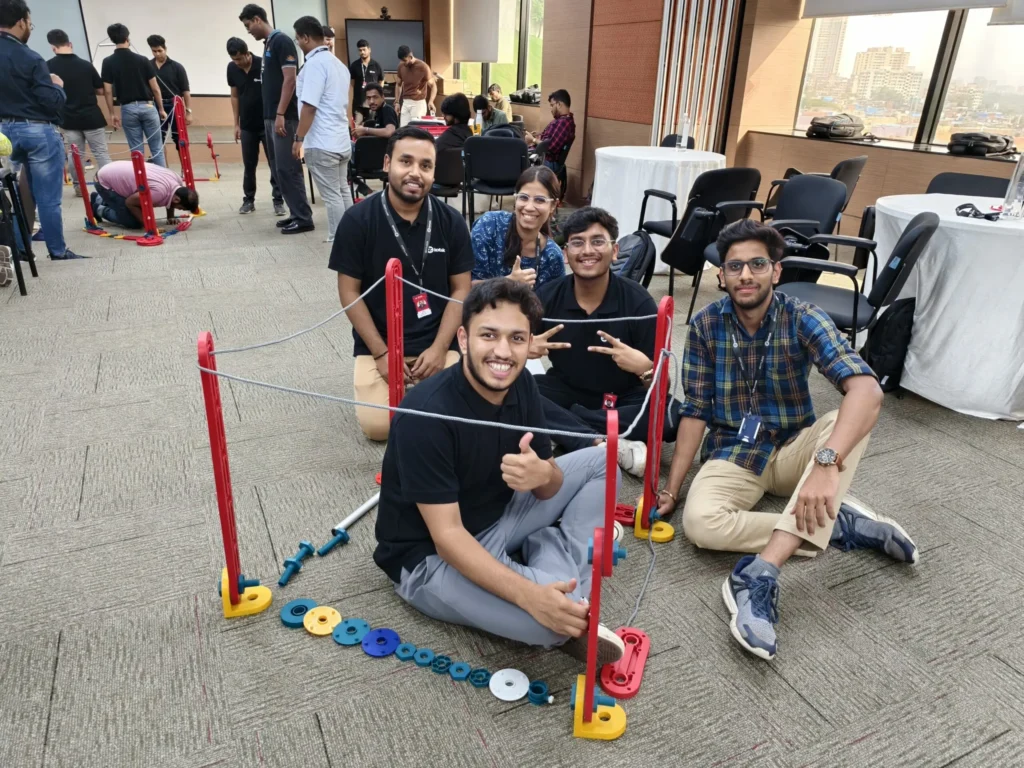
Quick Decision-Making Challenges Teams in Pune’s IT and product companies face constant prioritisation pressure. Our rapid-fire challenge formats put teams under time-constrained decision-making scenarios that reveal who defaults to perfectionism, who steps up under pressure, and who shuts down when ambiguity strikes. The debrief converts these observations into actionable leadership insights.
Interactive Problem-Solving Scenarios Modelled on real workplace situations — a failed product launch, a miscommunicated client brief, a cross-team dependency breakdown — these scenarios require teams to collaborate with deliberately incomplete information. Just like most Tuesday afternoons at work.
Rewards & Recognition Simulations We run structured simulations where teams must identify, appreciate, and publicly recognise each other’s contributions under pressure. For Pune’s large-scale IT delivery teams where individual contributions often get lost in project noise, this module creates breakthrough awareness of how recognition directly impacts team trust and performance.
The Science Behind Why It Works: Kolb’s Learning Cycle
For L&D professionals making the internal business case, here’s the framework. David Kolb’s model identifies four stages:
- Concrete Experience — doing the activity (the challenge, the simulation, the hunt)
- Reflective Observation — observing what happened and how your team responded
- Abstract Conceptualisation — extracting the principle (e.g., “our team defaults to the loudest voice rather than the clearest argument”)
- Active Experimentation — deciding what to do differently in the next real situation
Our facilitators guide teams through all four stages — not just the first. This is the step most team building vendors skip entirely, and it’s the step that determines whether the day actually changes anything when your team returns to work.
Which Pune Companies Benefit Most?
The honest answer: any company, at any growth stage. But here are the specific situations where Pune clients most often reach out to Team Building Ninja:
- IT services companies mid-project, when team communication has broken down under delivery pressure
- Pune pharma and manufacturing firms running annual L&D programs that need to feel less like mandatory training
- Startups in Baner and Wakad that have scaled quickly and are experiencing growing pains around culture and cross-functional alignment
- MNCs with Pune delivery centres onboarding large batches of campus recruits
- Leadership cohorts across Kharadi and Hadapsar preparing for managerial roles and needing real-situation exposure rather than theoretical frameworks
Why Pune Is the Right City to Invest in Experiential L&D Right Now
Pune’s talent market is highly competitive. Attrition rates in Hinjewadi’s IT corridor remain a persistent challenge, and employees increasingly cite “lack of growth and development” as a primary reason for switching companies.
Experiential learning programs signal to your team that their development is taken seriously. When a company invests in an L&D format that’s genuinely different from annual compliance training, it communicates that professional growth is real — not performative.
Beyond retention, Pune’s project delivery culture depends on teams that can self-organise, communicate under pressure, and adapt quickly. These are not skills you can lecture into existence. They need to be practised — safely, in a structured environment — before they’re needed on a live client call.
Experiential Learning vs. Standard Team Outing — A Quick Comparison
| Criteria | Standard Team Outing | Experiential Learning |
|---|---|---|
| Primary goal | Fun & morale | Skill development + fun |
| Facilitation | Event host | Trained L&D facilitator |
| Post-activity debrief | None | Structured reflection session |
| Measurable outcome | Employee satisfaction | Behaviour change indicators |
| Repeat value | Diminishes quickly | Compounds with repeat sessions |
| L&D alignment | Low | High — maps to competency frameworks |
What Makes Team Building Ninja Different for Pune Clients
- Delivered programs for teams from TCS, Cognizant, Wipro, Infosys, Volkswagen, Tech Mahindra, and Capgemini — many with Pune delivery centres
- Facilitators trained in experiential education methodology and corporate psychology — not just event management
- Every program co-designed with your HR or L&D team to align with specific competency frameworks or performance gaps
- Operate across all major Pune zones: Hinjewadi, Kharadi, Magarpatta, Viman Nagar, Baner, Wakad, and Hadapsar
- Venue-agnostic delivery — your campus, a resort in Lavasa, or a conference centre near Shivajinagar
Frequently Asked Questions
Is experiential learning only for large teams?
Not at all. Some of our most impactful Pune sessions have been with senior leadership cohorts of 12–15 people. Smaller groups allow for deeper reflection and more honest conversation.
Can this be combined with a fun outdoor outing?
Absolutely. Many Pune clients run our experiential modules in the morning and transition to a relaxed team lunch or activity in the afternoon. Work and play don’t need to be separate events.
How is success measured?
We provide pre- and post-activity feedback reports and can align outputs with your existing competency assessment frameworks for measurable L&D impact.
Do you work with hybrid or remote Pune teams?
Yes. We run experiential programs in virtual and hybrid formats designed specifically for distributed teams — keeping remote employees as engaged as those in the room.