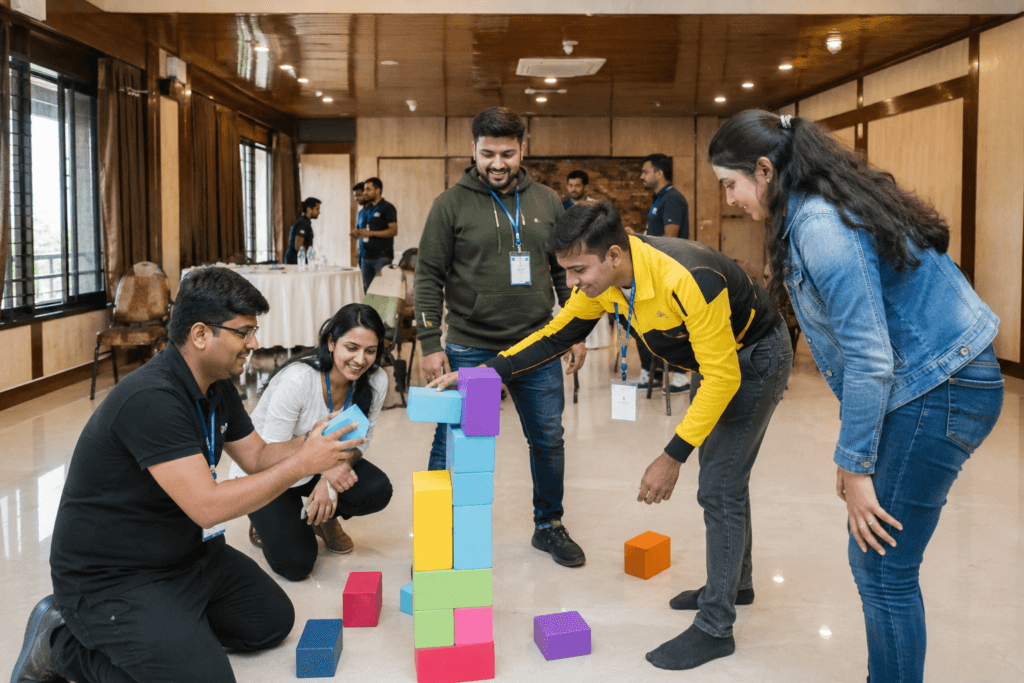
Strong communication is one of the foundations of an effective team. When employees communicate clearly, listen actively, and understand how their colleagues think, teams can collaborate more effectively, solve problems faster, and avoid unnecessary workplace conflicts.
However, communication skills aren’t always developed through meetings and presentations alone. Team-building activities give employees an opportunity to practice communication in a fun, interactive environment.
From creative challenges and problem-solving games to communication-based team exercises, the right activity can help employees build trust while learning how to work better together.
In this guide, we’ll explore 8 fun team-building activities that can improve workplace communication, along with the communication skills each activity helps develop.
On This Page
- What are communication-focused team-building activities?
- Why is communication important for team building?
- 8 team-building activities to improve communication
- Tips for improving communication in the workplace
- How to choose the right team-building activity
What Are Communication-Focused Team-Building Activities?
Communication-focused team-building activities are interactive exercises designed to help employees practice skills such as active listening, clear communication, collaboration, decision-making, and problem-solving.
Instead of simply talking about communication, employees experience situations where they need to communicate effectively to complete a challenge.
For example, one employee may need to describe an image while another person recreates it without seeing the original. In another activity, a team may need to solve a challenge using limited information and resources.
These experiences can reveal how teams communicate under pressure and help employees identify areas they can improve.
Why Is Communication Important for Team Building?
Good communication helps employees understand responsibilities, share ideas, provide feedback, and work toward common goals.
Communication-based team-building activities can help teams:
- Improve active listening
- Build trust between colleagues
- Encourage employees to share ideas
- Develop better problem-solving habits
- Reduce misunderstandings
- Improve collaboration
- Strengthen interpersonal relationships
- Encourage leadership and decision-making
- Create a more positive workplace environment
The key is to choose activities that are enjoyable while also giving participants a clear opportunity to practice workplace communication.
8 Team-Building Activities to Improve Communication
Here are eight engaging activities that can help employees improve communication and teamwork.
- Back-to-Back Drawing
- Silent Line-Up Challenge
- Escape Room Challenge
- Blindfold Navigation
- Story Building
- Human Knot
- Marshmallow Tower Challenge
- Team Scavenger Hunt
1. Back-to-Back Drawing
Best for: Active listening and clear instructions
Back-to-back drawing is a simple communication exercise that requires two employees to work together.
Pair participants and ask them to sit back-to-back. One participant receives a simple picture or geometric design, while the other has a blank sheet of paper.
The person with the picture must describe it without showing it to their partner. The other person must recreate the image based only on the instructions they receive.
After the activity, compare the original image with the drawing.
What does this activity teach?
This exercise highlights the importance of:
- Giving specific instructions
- Asking clarifying questions
- Listening carefully
- Avoiding assumptions
- Communicating ideas clearly
It can also lead to an interesting discussion about how small communication gaps can affect workplace projects.
Team-building tip: Run the activity twice. During the second round, allow the listener to ask questions. Compare the results to show the value of two-way communication.
2. Silent Line-Up Challenge
Best for: Non-verbal communication and teamwork
Ask participants to arrange themselves in a specific order without speaking.
For example, employees could be asked to line up according to:
- Birthday month
- Years of work experience
- Height
- Distance travelled to the office
- Number of years with the company
The challenge is that participants cannot use words. They must rely on gestures, expressions, and other forms of non-verbal communication.
What does this activity teach?
The Silent Line-Up Challenge encourages employees to think about how much information can be communicated without speaking.
It develops:
- Non-verbal communication
- Observation
- Patience
- Cooperation
- Creative thinking
It is also a quick activity that can work well as an office team-building icebreaker.
3. Escape Room Challenge
Best for: Problem-solving and collaborative communication
An escape room-style challenge places a team in a situation where they must solve clues, puzzles, and problems within a limited amount of time.
Participants may discover different clues or pieces of information, meaning the entire team needs to communicate what they find.
One person might notice a pattern while another understands how to use it. Success depends on bringing these pieces of information together.
What does this activity teach?
An escape room challenge can encourage:
- Information sharing
- Active listening
- Team decision-making
- Delegation
- Time management
- Problem-solving
- Leadership
The activity can also reveal different team dynamics. Some employees naturally take leadership roles, while others excel at observing details or solving complex problems.
4. Blindfold Navigation
Best for: Trust and verbal communication
Divide employees into pairs. Create a safe obstacle course using cones, soft objects, or other suitable markers.
One participant is blindfolded while their partner guides them through the course using verbal instructions.
The person wearing the blindfold cannot see the obstacles, so they must rely on their partner’s directions.
What does this activity teach?
Blindfold navigation can help employees understand the importance of:
- Giving precise instructions
- Listening carefully
- Building trust
- Staying calm under pressure
- Providing constructive guidance
For workplace events, make sure the activity is conducted in a safe, obstacle-free environment with appropriate supervision.
The main lesson isn’t about speed. It is about how effectively two people can communicate when one person depends on the other’s instructions.
5. Story Building
Best for: Creativity and collaborative communication
Story Building is a simple activity that can be played with small or large groups.
Ask one participant to begin a story with a sentence. The next person adds another sentence, followed by the next participant.
For example:
“Our team arrived at the office on Monday and discovered a mysterious box…”
Each employee continues the story while connecting their contribution to what came before.
To make the activity more challenging, give teams a theme such as:
- A workplace adventure
- A product launch
- A team stranded on an island
- A futuristic office
- A company mystery
What does this activity teach?
Story Building encourages employees to:
- Listen to previous ideas
- Build on other people’s contributions
- Think creatively
- Communicate clearly
- Accept different perspectives
It is particularly useful for teams that want a lighthearted communication activity without complicated equipment.
6. Human Knot
Best for: Cooperation and problem-solving
Ask a group of participants to stand in a circle. Each person reaches across the circle and holds the hand of another participant.
Once everyone is connected, the group must work together to untangle themselves without letting go.
The challenge may look simple at first, but it quickly requires participants to communicate and coordinate their movements.
What does this activity teach?
Human Knot encourages:
- Team coordination
- Patience
- Problem-solving
- Verbal communication
- Leadership
- Cooperation
The activity works particularly well for teams that need an energetic break from traditional meetings or workshops.
Important: Provide enough space and avoid forcing movements that could cause discomfort or injury.
7. Marshmallow Tower Challenge
Best for: Collaboration and decision-making
Divide employees into small teams and provide each group with materials such as:
- Spaghetti sticks
- Tape
- String
- One marshmallow
Give teams a limited amount of time to build the tallest freestanding structure possible, with the marshmallow placed at the top.
The challenge requires teams to quickly discuss ideas, divide responsibilities, test designs, and adapt when something doesn’t work.
What does this activity teach?
The Marshmallow Tower Challenge can develop:
- Collaboration
- Creative thinking
- Decision-making
- Leadership
- Planning
- Adaptability
It also demonstrates why teams should be comfortable testing ideas instead of spending too much time trying to create a perfect plan before taking action.
8. Team Scavenger Hunt
Best for: Communication, collaboration, and employee engagement
A team scavenger hunt turns communication into an interactive challenge.
Divide employees into teams and give them a list of clues, questions, objects, or tasks they need to complete within a set time.
Challenges could include:
- Finding specific objects
- Solving riddles
- Taking creative team photos
- Completing workplace challenges
- Answering company-related questions
- Solving location-based clues
Teams must communicate, divide responsibilities, and decide which tasks to complete first.
What does this activity teach?
A well-designed scavenger hunt can strengthen:
- Team communication
- Delegation
- Time management
- Collaboration
- Creative problem-solving
- Leadership
- Team spirit
For corporate events, scavenger hunts can also be customized around a company’s culture, values, products, or workplace environment.
Tips for Improving Communication in the Workplace
Team-building activities can create opportunities to practice communication, but the lessons should continue after the activity ends.
Here are a few practical ways to strengthen communication within your workplace.
1. Encourage Active Listening
Communication isn’t only about speaking.
Employees should also learn to listen without interrupting, ask questions, and confirm that they understand what another person is saying.
Simple habits such as summarizing key points after a discussion can prevent misunderstandings.
2. Encourage Employees to Ask Questions
Some communication problems happen because employees are hesitant to ask for clarification.
Create an environment where asking questions is considered a positive part of collaboration rather than a weakness.
3. Make Communication Two-Way
Effective communication should allow employees to share ideas and feedback.
Managers can encourage this by asking team members for their opinions during meetings and giving employees opportunities to contribute.
4. Use Team-Building Activities Regularly
A single team-building event can be enjoyable, but regular activities can help teams continue practicing collaboration and communication.
You can combine short workplace activities with larger corporate team-building events throughout the year. For frequent, low-cost sessions, our guide on budget-friendly team building activities has practical ideas that work well for regular, ongoing engagement without straining your HR budget.
Related: Employee Engagement Activities
5. Create a Safe Environment for Ideas
Employees communicate more openly when they feel comfortable sharing ideas.
Encourage respectful discussions where team members can disagree, ask questions, and suggest alternative solutions without fear of being dismissed.
How to Choose the Right Communication Team-Building Activity
Not every activity will work equally well for every team.
Before choosing an activity, consider:
Team Size
Some activities work best with pairs or small groups, while others can accommodate larger corporate teams.
Team Goals
Identify what you want employees to improve.
For example:
- Communication
- Trust
- Leadership
- Creativity
- Problem-solving
- Collaboration
- Employee engagement
Workplace Environment
An indoor office activity may be more suitable for a corporate office, while outdoor activities can provide more space for larger and more energetic challenges.
Employee Comfort
Consider accessibility, physical requirements, personality differences, and comfort levels when selecting an activity.
Time Available
A five-minute communication game can work during a meeting, while a full team-building event can include multiple activities and structured challenges.
Build Better Communication Through Team Building
Communication becomes stronger when employees have opportunities to practice listening, sharing ideas, solving problems, and working together.
Activities such as back-to-back drawing, silent challenges, escape-room games, blindfold navigation, story building, human knot, tower building, and scavenger hunts can turn these skills into engaging team experiences.
The best team-building activities aren’t simply about having fun. They create situations where employees need to communicate, collaborate, trust one another, and work toward a shared goal.
If you’re planning a corporate team-building event, choose activities that match your team’s size, goals, workplace environment, and employee interests.
Team Building Ninja can help organizations create engaging team-building experiences designed around communication, collaboration, employee engagement, and teamwork.
Explore Team Building Activities
Plan a Corporate Team-Building Event
Frequently Asked Questions
What team-building activity is best for communication?
Activities such as back-to-back drawing, blindfold navigation, scavenger hunts, and collaborative problem-solving games can help employees practice clear communication and active listening.
How do team-building activities improve communication?
Team-building activities place employees in situations where they need to listen, share information, solve problems, and coordinate with others. This gives participants an opportunity to practice communication in an interactive environment.
What is a quick communication team-building activity?
Back-to-back drawing and silent line-up challenges are simple activities that can be completed in a relatively short time and require minimal equipment.
What are some team-building activities for large groups?
Scavenger hunts, large-group problem-solving challenges, interactive games, and outdoor team-building activities can work well for larger groups.
Can team-building activities improve employee engagement?
Yes. Well-designed activities can give employees opportunities to interact outside their normal work routines, build relationships, collaborate, and participate in shared experiences.
How often should companies organize team-building activities?
There is no single schedule that works for every organization. Companies can combine short communication exercises during regular workdays with larger team-building events throughout the year.